Archive for the 'perception' Category


249. Who?

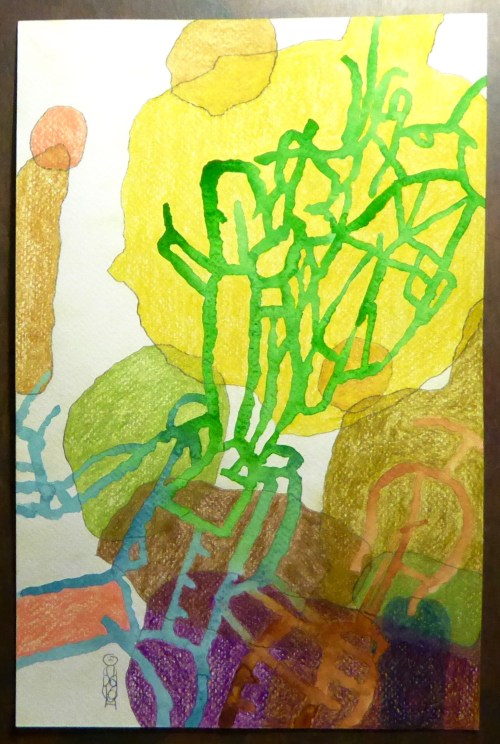
p1000383

Which direction do you grow?

To where the joy will take me.

What do you hold on to?

Nothing.

And who is looking at you?

I alone look at me.

There is nobody else

Anywhere.

248. A second reading

from entry 245

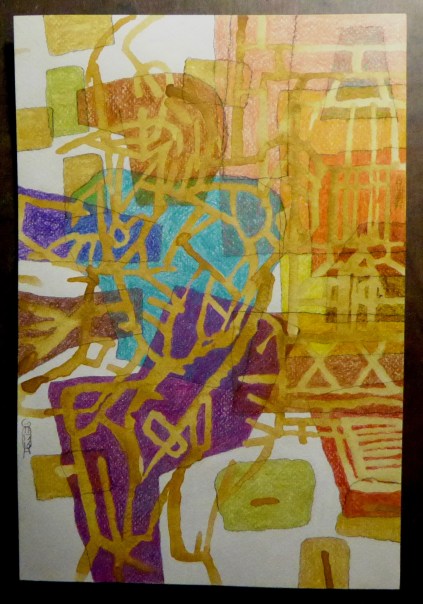
Painting from entry 245

What else can we see in this painting?

The colors in the architectural area on the right side are warm and feel comfortable with each other.

The colors in the man are colder and more contrasting with each other.

Can it be that the man is somewhat conflicted, and maybe feels that he is leaving a comfortable place by being attracted to the unknown?

The man’s interest is somewhere in the left, outside of the painting. But he is seated. We do not see him going to the left. Can it be that he hesitates?

There is a lot of activity in the drawing layer. Can it be that a lot of thinking is going on?

And yet there is in the painting the clarity of seeing what is going on. And when there is that depth of seeing that happens because there is an identification with the flow of intuition, we know that a change will come soon. Seeing from a deeper state, which is what awareness is, releases the shallower layer to start moving. And because the state of awareness is a feeling better state, the next state to appear will adjust itself to the better feeling awareness by being a better feeling state.

You see? This is the power of awareness. This is why awareness is so good for us. Just being aware, or seeing from a deeper layer of ourselves, changes us for the better. Better here means feeling better. Isn’t feeling better better?

247. For this time

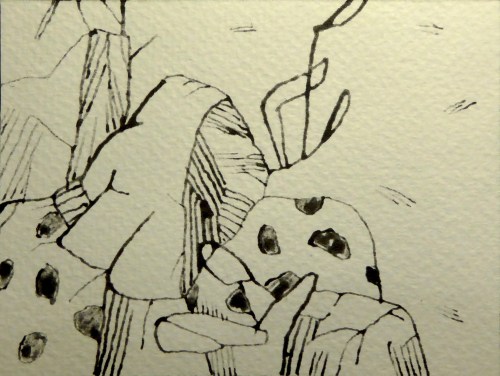
p1000381

In some place

Like in so many others

For this moment

The plant is attached to the tip of the world


The balance of flat and broken and empty

Of dots and leaves and feathers

Depends on

One very thin line


In a way that is unknown to us

The open chord of feathers in the moving air

Is perfect

For those who also like dots on a white surface


This is a rock

For children

Who make rocks and plants

From dreams.

245.From dense to airy

p1000377

I’m reading this picture, based on its composition. This will be a preliminary reading. I’ll point out a few obvious things and see what I can gather from this. It is possible to read much more in the picture, and maybe I’ll do this in the next entry.

It has two layers, as many of my paintings lately. The drawing layer has three areas. The right side has many architectural shapes. It is organized in mostly perpendicular and horizontal directions, with a few diagonals, that you can find in architecture too.

The left side has shapes that are more organic. The shapes are free from the straight angles of the right side and they grow into each other. The third area is where there is no drawing, or only little short lines that seem to float in space. That’s where there is less density and more freedom.

The pencil lines, those that define the colored areas, go on top of the watercolor lines. In this way they create some confusion, because the colors inside of the pencil lines are all underneath the ochre lines of the drawing. This contradictory message creates a strong connection of the background shapes and the drawing, indicating that the two layers are very close to each other and depend on each other to tell the story of the picture. And it is hard to decide what is more important or primary.

The color shapes in the right side go along with the feeling of architecture or a city. The color shapes on the left go along with the feeling of an organic shape, something that is alive and moving. It is like a person in a sitting position. His two hands are extended to the far left, and it seems that he is doing something outside of the picture.

And there is indeed space around the person and the part of the city that we see. Some smaller shapes float there, breaking the density of the city and the man and giving the picture some places with less tension to rest in.

So the focus of the man is in the more spacious area. That’s what he is interested in.

Basically we have a transition from an area that is densely full of visual events, through more relaxed shapes, that break the straight lines rule, to the beginning of space, into which the smaller pieces of the reality that’s on the right are falling or spreading.

In a shorter way, the picture shows the shift from eventful and intense reality to more peacefulness and freedom.

This is an experience of the now-life that we can read in the basic features of the composition.

If I ask myself where would I want to be, in this picture, the answer is “In all three places.”

I’d like to experience the peace that is outside of the objects, I’d like to experience the richness of the city, and I’d like to experience my body, alive and feeling.

And as I have all three of them at the same time, I can say that I am fulfilled. In this fulfillment there is peace too, till the next interest will catch me.

Isn’t this amazing that from so little you can say so much already?

I do not know what name to give this new chapter. Everything is different for me, and the same. I decide to let the chapter grow and deserve a name, and then it will have it.
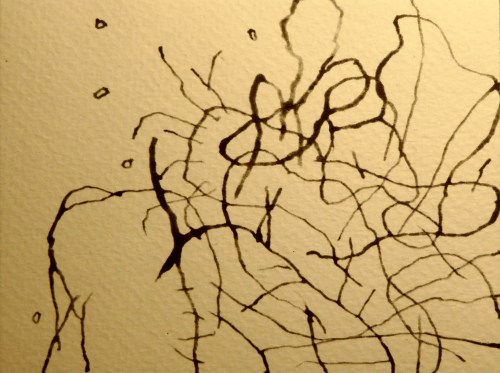
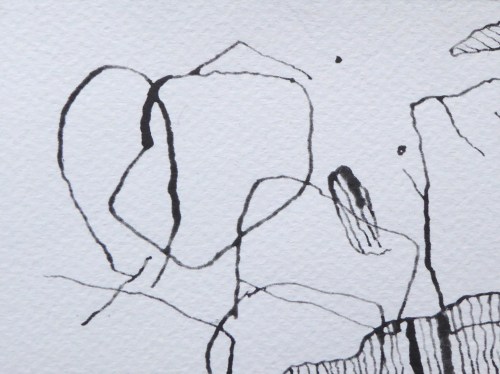
244.Closing the door of this chapter and opening the door of the next one.

p1000375

And today it happened. Today I understood how you can love everything in your earth life, including the suffering. Because you see the beauty of the game that you, the bigger you, has and is still creating.

You are lead into a blind alley that you create and the keys are handed to you. And don’t worry. This is not a contest. The doors will keep appearing. The smells will cross the barriers of the ends of reality. The sun will rise in you, unstoppable. So don’t worry. Take it all in, as this is what you are here for: To take it in and to crack the walls at the same time. And you cannot even say that this reality does not exist.

What becomes clear is the reality of your experiencing and the opening of your expression of the truth.

Maybe this is a nice place to end this part of the blog, and to start a new part. Let’s see where it will go…

243. (re)Discovering

p1000350

Discovering who you are is the main issue of life on earth.

You can find yourself in many ways and in many places and things. Actually, in every thing.

The best way is through doing what you love to do and taking this way as a trip to the depth of who you are.

You will change along the way, and maybe what you love doing more than anything else will change too. You have to always choose to do what you most love at the moment.

You will start finding yourself in small steps or maybe big. And every time you find yourself, you will feel satisfied. Finding yourself is the source of satisfaction. I want to say the only source, but I’m not sure yet. All this knowledge comes to me as a surprise, and at the same time as something that I have known before.

After the satisfaction periods you will start being curious again, and you will again use doing what you most love at that time to move on towards the depths of yourself.

All of the trip happens between you and eternity, which is you too.


242. What do you want to do now?

The trees brush your window

The trees brush your window

The trees brush your window

The precipice steals your breath

The cloud calls you to fly with him.

What do you want to do now?

With your morning coffee cup in hand

You let your dreams glide among the trees

To the horizon and beyond.

What do you want to do now?

You know how the trees negotiate their growth

To agree with their surroundings

You know, as you had made them be that way.

What do you want to do now?

The sky

Of sweet air

Always comes to you.

What do you want to do now?


240. Look back with your eyes closed

P1000307

Try this:

Close your eyes.

Sit comfortably somewhere of course.

Find something that your senses detect.

An example: The eyelids touching each other.

Imagine that your whole world is made of transparent clay. This clay makes everything and is not seen. This clay makes everything it wants. The things it makes appear to our senses.

Your clay creates the eyelids, the nerves that sense them touching each other and your same clay is the one who sees it all, from inside of itself.

Let’s say you hear a car on the road. Your clay is making it in this moment. Your clay is making the road. Your clay makes the sound. Your clay is making your ears and all their parts, right now.

What is this clay?

Why does it make these things?

Maybe out of curiosity? Out of the love of experiencing? Out of joy?

Playing like a baby?

Is it you?

Where does this clay come from?


Look back, from inside the clay, with your eyes closed.


239. The veil

IMG_1458

I looked at painting 7/3/16/A.

I started to read it again. Yesterday I read it psychologically (which you didn’t see), and the reading shifted to a bigger view of all psychology, as I’ve been doing lately. Obviously I am in a stage, in which I notice more and more the superficiality of the psychological realm altogether. I understand my meditation teacher’s belittling attitude towards everything psychological. I was, at the time he was doing this, studying psychology as part of becoming an art therapist.

For most people the psychological view widens and deepens their understanding of the human being. It was so for me too. How amazed and thankful I was when I realized that I could read all this hidden treasure in people’s art. And I played in this field for quite a while, enjoying my ability to easily see what is hiding there, and my resultant ability to help people see their own subconscious activity and release its powerful control over them.

Then, very quickly I saw that if you release a lot, you will experience how it is to live with less inhibiting ideas blocking you from being free. The psychological relief became a path of spiritual growth. I tasted the joy that becomes unleashed. I lived the love that streams freely unburdened.

And at some point it became clear to me that those psychological features, the killers of joy and freedom, are the building blocks of the personality. Just a small dip in the non-physical aspect of life makes it totally transparent that this character, this personality, is just a bunch of habits. You look from a deeper place and see the inflexibility of these personality traits as they inevitably cause people to bump into each other quite blindly, respond to each other uncontrollably and create all the unpleasant situations that we know.

Then you realize that what is left in you once these psychological features are let go of, is so much better than these.

What can be better than love?

What is wrong with joy that does not depend on circumstances, but is your inherent essence?

The whole psychological realm starts to look like a veil or a filter that you can look through. At first the view is dim and then it starts brightening. The veil looses all its previous power. Your personal veil becomes just one of the infinite number of empty energetic shapes, that you create in your imagined thought-world. And because you love the characteristics of your essence so much more than the personality’s character, your world starts to reflect back to you what you already experience, the beauty, the creativity, the joy and love. These are what the world is becoming for you.


235. Take the inner world out

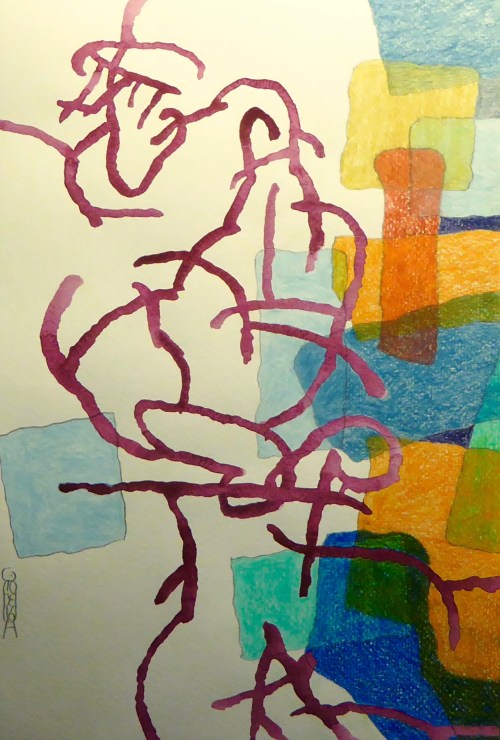
P1000265

There are the lines and there are the color shapes. They seem to describe the same thing but they have very different perspectives.

Sometimes, in other paintings, the lines and the shapes do not necessarily describe the shame thing. If we compare this to music, then those paintings are like counterpoint. The lines have a tune and the color shapes have a different tune. But when they are placed on top of each other, the music makes sense. The music becomes richer by the working together of different tunes.

This painting is more like a tune with chords. The chords accompany the tune that the lines make.

If we look at the lines, trying to see the character of the tune, in my opinion, it is hesitant, even afraid somewhat. It tries to describe something but we cannot identify what it is. In a way it is like what toddlers do sometimes, when they pretend to be writing words and sentences but they don’t yet know how to write. So the lines only looks as if they are describing shapes. There is humor in that.

Now if we look at the color shapes, they don’t seem to be worried at all. They seem to be happy. They come together to share an activity and while playing together they keep their independence and individual identities. They seem to be playful and enjoying the game that they play.

If we describe the music here, it may be something like this: on the background of freely moving pleasant chords, the tune is hesitant. Its parts hold on to each other as if they are afraid to fall apart. There is no sense of freedom in the tune. It seems to be working hard, trying to fulfill some duty or necessity. It is a bit ridiculous in its efforts to describe everything in detail while it is impossible to decipher what it describes.

The chords in this piece of music are strange. They are a mixture of pleasant and unpleasant feelings.

I actually like that kind of music.

But if this were the description of a person, what would you want to tell him?

Maybe it will be, to let go of some of the seriousness with which it takes the story line, and give some attention to the deeper layer of himself, where the playfulness, freedom and maybe even the beauty of life’s experiences can be felt. This layer is so close…

But the story won’t stop. And we are here for the story, aren’t we?

So maybe it is possible to take some of the character of the inner layers of who we are and bring it with us outside, when we create the lines of our stories. Maybe we will then make lines that are a bit freer and happier than before?


Awards

Enter your email address to subscribe to this blog and receive notifications of new posts by email.

Join 1,525 other subscribers

My Pages

The healing process

Entries 1-58 show how I use the method of Intuition Through Art to heal myself from Peripheral Neuropathy.

Archives